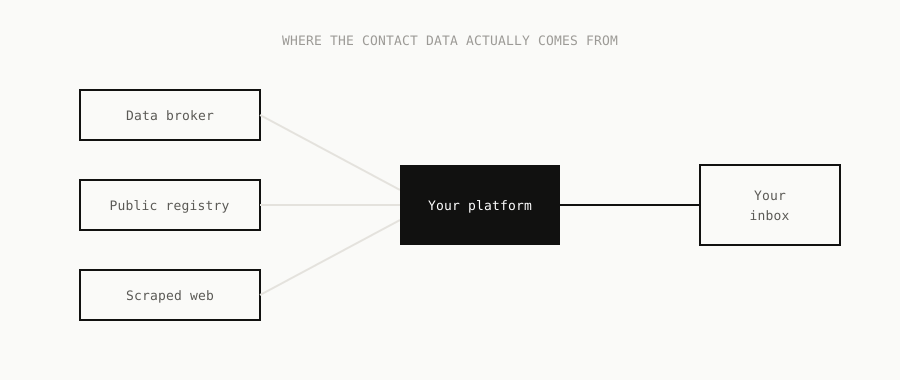
Instantly, Smartlead and Lemlist get lumped together constantly, and for good reason — they solve a similar problem (sending and managing high-volume cold email) with a similar underlying approach to leads. Understanding how that approach works is useful whether or not you end up using any of them, because it explains both their strengths and a specific gap in what they do.
The shared model: database-first sourcing
All three platforms are built primarily as sending and deliverability infrastructure — warm-up, inbox rotation, reply detection, sequencing — with lead sourcing bolted on either natively or through integrations with contact database providers. Instantly ships its own lead finder pulling from a large licensed contact database, filterable by industry, title, company size and location. Smartlead leans more heavily on integrations, letting users plug in data from providers like Apollo or Clay rather than owning the sourcing layer itself. Lemlist sits somewhere in between, with its own database plus enrichment add-ons.
The practical effect is the same across all three: you're filtering a shared pool of firmographic and contact data that many other users of the same tool, and often users of competing tools, are also filtering. The differentiation between two agencies using the same platform against the same target segment often comes down entirely to copy and volume, because the underlying list-building mechanism is close to identical. We spot-checked this overlap directly — see the studies page for the sampling.
What this model is genuinely good at
Database-first sourcing is fast, cheap per contact, and scales to volumes that manual or signal-based list building can't match in the same timeframe. If the goal is broad market coverage — testing a new offer against thousands of businesses quickly to find any pocket of response — this is the right tool for that job. Sales teams running high-volume top-of-funnel motions with a genuinely differentiated core offer do well on this model, because the offer is doing the work the list doesn't.
Where it runs into limits
The limit shows up specifically when the offer needs the list to do part of the persuading — which is most of the time in competitive categories like web design, marketing services, and other agency-to-agency or agency-to-SMB outreach. The recipient has heard some version of "we can improve your website/marketing/leads" dozens of times, often that same week, often from tools drawing on the same database. Personalization tokens pulling in a company name or industry don't meaningfully change that experience; recipients can usually tell.
There's also a compounding deliverability effect worth naming. As more senders draw from overlapping databases and similar AI-personalization patterns, spam filters get better at pattern-matching the structure of that outreach regardless of specific wording. Google's own sender guidelines have gotten measurably stricter about high-volume, low-engagement sending patterns over the past few years, and database-sourced lists — being inherently less targeted — tend to produce exactly the lower engagement rates that trigger that flagging.
Where the cost actually sits
It's also worth pricing the two approaches on the same basis, because the sticker prices are misleading on their own. A mid-tier plan on any of these three platforms plus a bolted-on database subscription typically lands somewhere in the low hundreds per month for tens of thousands of contacts — cheap per name. Signal-based sourcing costs more per contact because someone has to verify the condition exists, but the list is a fraction of the size and the close rate on what does convert tends to be meaningfully higher, which is the number that actually determines cost per client acquired rather than cost per name in a spreadsheet.
The honest comparison
None of this makes these platforms bad — they're well-built for what they're built for, and for a lot of outbound motions, sending infrastructure plus a broad database is genuinely the right combination. But it's worth being clear-eyed about what you're paying for: excellent delivery mechanics on top of a contact-matching layer, not a diagnosis of who's actually likely to respond. If your outreach is failing on reply rate rather than deliverability, the sending tool usually isn't the bottleneck — the sourcing model underneath it is. That's the same gap the diagnostic prospecting framework is built to close.