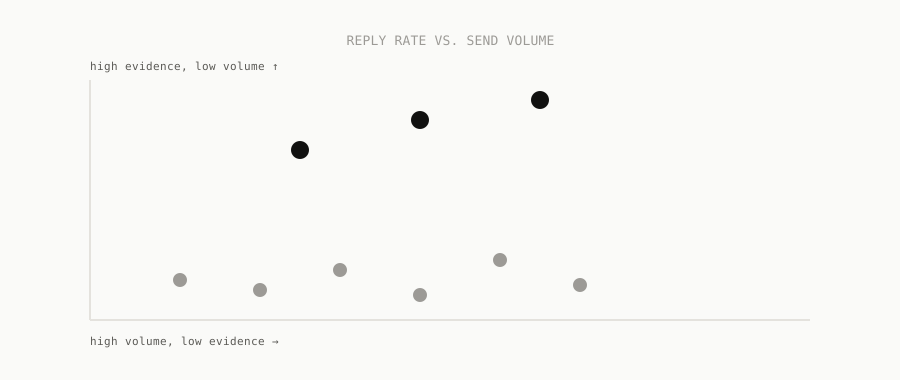
Every agency I've worked with or advised has, at some point, responded to a slump in cold outreach replies the same way: send more. Double the daily volume, add a second mailbox, buy a bigger list. It's an understandable instinct — more attempts should mean more responses, roughly — but in practice it's usually the reason the slump continues instead of the fix for it.
The volume trap
Cold email reply rates aren't fixed per email; they're a function of how relevant each email is to its specific recipient, multiplied across the batch. Doubling volume without changing relevance doesn't double replies — it usually holds absolute reply count roughly flat while cutting reply rate in half, because you've added the same number of low-relevance sends. Worse, it accelerates deliverability damage: sending domains are increasingly evaluated on engagement ratios, not raw volume, so a lower reply and open rate at higher volume is close to the worst combination for staying out of spam folders. We logged this pattern directly across our own sending domains — details on the studies page.
I've watched this cycle play out across several agencies I've advised: replies drop, volume goes up in response, deliverability degrades over the following weeks, replies drop further, and the response is to increase volume again. It's a genuinely vicious loop, and it's driven by treating volume as the default lever when the actual problem is almost always upstream, in targeting.
What "evidence" means here
By evidence, I mean something concrete and specific about the recipient's situation that the email can point to — not a personalization token, but an actual observation. "I noticed you're not running any paid search despite ranking on page three for your main keyword" is evidence. It required someone or something to actually look at that business specifically. It reads differently to the recipient than a templated email with their company name dropped in, because it is different — the amount of actual attention paid to them personally is different, and people can tell.
Why agencies default to volume anyway
Volume is easier to control and easier to report on. "We sent 2,000 emails this month" is a number you can put in a client update. "We identified 40 businesses with a specific, provable problem and reached out individually" sounds smaller and slower, even when it's the version that's actually working. This creates a structural bias toward volume-based reporting inside agencies, independent of what's actually driving results.
One agency, two quarters
An agency I advised last year ran exactly this experiment without meaning to. Q1: 60 emails a day per mailbox, generic vertical targeting, no researched detail in the opener. Reply rate sat at 1.4%, and about a third of replies were unsubscribes rather than interest. Q2, under pressure from a client asking why bookings were flat, they cut volume to 18 emails a day per mailbox but required every one to reference something specific and checkable about the recipient's business. Reply rate rose to 6.8%, and unsubscribes as a share of replies dropped to under 5%. Total booked calls for the quarter, despite sending roughly a third of the email volume, went up.
The part that surprised them wasn't the reply rate — they expected some lift. It was that domain health scores, which had been quietly degrading for months, recovered within about five weeks of cutting volume, without anyone touching sending infrastructure.
The reframe that helps
The agencies that break the cycle tend to make the same shift: they stop measuring outreach success by emails sent and start measuring it by qualified conversations started per hundred sends. That single change in what gets reported forces attention back onto targeting quality, because it's the only lever that moves that ratio. Volume becomes a secondary decision — how much capacity do we have to process a genuinely qualified list — rather than the primary strategy.
None of this means small volume is automatically good; a tiny, poorly targeted list fails just as completely as a huge one. Volume amplifies whatever targeting quality is already there. Fixing the targeting first and scaling the volume of a proven approach second is a slower path in the short term and a far more durable one over a quarter. It's the same shift covered in why the list matters more than the copy.