Two changes, one variable held constant
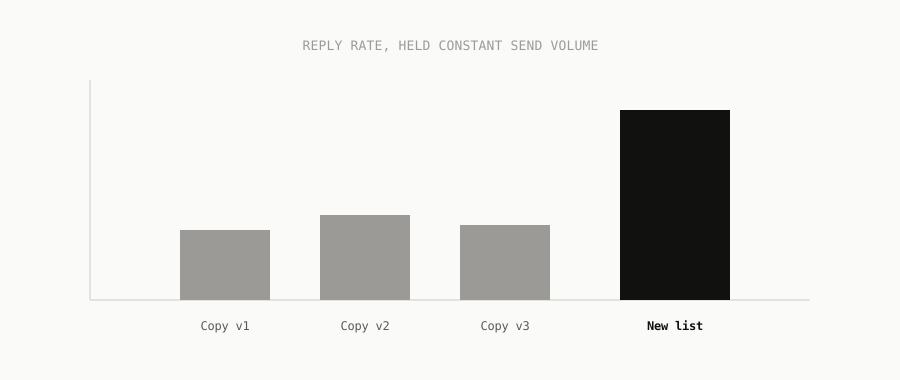
Four months into running cold outreach for my own agency, I ran what was basically an accidental experiment. For the first stretch, I left the list alone and rewrote the email every week — new subject lines, new openers, shorter, longer, more casual, more formal. Reply rate barely moved.
Then I did the opposite: kept the copy fixed and changed only the list. Reply rate jumped several times over within three weeks. Same sender, same offer, same words. The only variable that changed was who the email was going to.
That's not a fluke result. It's consistent with what we've logged since across Studio Utexo's own outbound — see the full breakdown on our studies page — and it's the reason I'd tell anyone stuck on reply rates to stop touching their copy before they've questioned their list.
What a firmographic list actually tells you
A list filtered by industry code, employee count, or revenue band tells you a business exists in a category. It doesn't tell you the business currently has a problem, or that it's in a position to act on one. Betting on relevance from category membership alone is a weak bet — most businesses in any category are, at any given moment, not actively looking to change anything.
A list built around an observable condition instead — a broken checkout, an outdated CMS, a mobile load time over six seconds — starts from relevance rather than hoping for it. Every business on that list has a provable problem before you've written a sentence.
The deliverability angle most people miss
This isn't only about reply rate. Inbox providers increasingly weight engagement — opens, replies, complaints — when deciding where to route mail. A list of people with no reason to care produces low engagement regardless of copy quality, and low engagement is the exact signal that gets sending domains throttled. A bad list doesn't just get worse replies; it damages your ability to send at all. We go into more of the domain-reputation data behind this on the studies page.
Three things that actually move the number
- Specificity of the problem cited. "Your site could convert better" gets ignored. "Your checkout drops mobile users at the payment step — tested it Tuesday" gets replies, because it's falsifiable and clearly required someone to look.
- Timing relative to a real event. A business that just changed a listing, launched a page, or had a review spike is more reachable than one sitting static for two years.
- Volume discipline. Lists built around real signal are naturally smaller. Forty relevant emails a day beats four hundred generic ones, in replies and in domain health.
What we actually saw in the numbers
The test that convinced me wasn't clean in the way case studies usually pretend. Same 5-email sequence, same domain, same sending window. Week one: a firmographic list of 400 mid-market SaaS companies, 20-200 employees, US only. Nine replies, two of them from someone asking to be removed. Week three, same sequence, swapped in a list of 140 companies flagged for a specific thing — a pricing page that hadn't changed in over a year despite a competitor undercutting them publicly. Nineteen replies, four booked calls. A third the volume, more than double the replies, and the calls that came out of it closed at a rate the first list never touched.
What made the second list work wasn't cleverness. It was that every name on it had already, provably, done the thing the email was about. Nobody had to be persuaded that the problem existed — they'd just never been told someone noticed.
None of this means copy is irrelevant — a bad email to the right person still fails. But a good email to the wrong person fails first, and quietly. It just looks like "cold email doesn't work for us," which is usually a list problem wearing a copy costume. If you're on your third subject line rewrite this month, it's worth putting it down and asking whether the list underneath actually describes people with a problem, or just people who exist. The diagnostic prospecting framework covers how to score a list on exactly that basis.