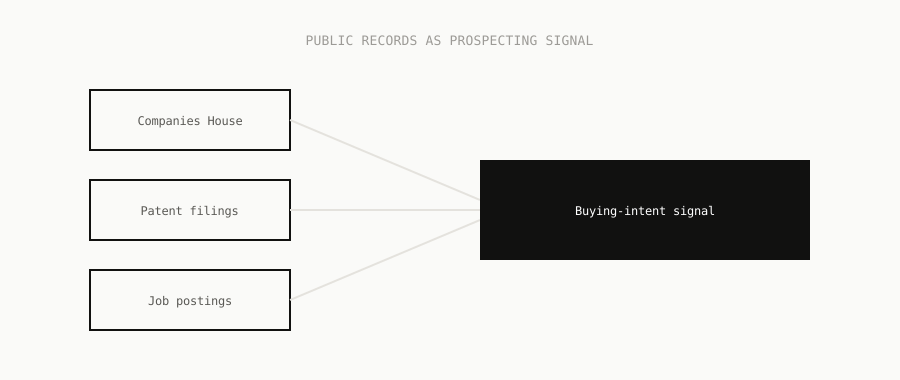
Most agencies pay a monthly subscription for contact and firmographic data without ever looking at what their own country's business registry already publishes for free. In the UK, that's Companies House. In the US, it's a patchwork of state-level Secretary of State filings and SEC records for public companies. Neither is glamorous, but both contain signal that's genuinely difficult to buy anywhere else.
What's actually in there
Companies House, for example, publishes incorporation dates, registered office changes, director appointments and resignations, filing history, and — for many companies — basic financial statements. None of that is contact data in the way a sales database provides it, but it's timing and trigger data, which is arguably more valuable and much less commoditized.
A few specific signals worth building around:
- Recent incorporations. A business registered in the last 3-6 months is, almost by definition, actively building infrastructure — website, brand, systems — that older businesses already have. That's a different conversation than pitching an established company on a redesign.
- Director changes. New leadership frequently means new priorities, new budget authority, and a natural window to introduce a service the previous decision-maker had already dismissed or ignored.
- Filing gaps or status changes. Administrative signals like overdue filings can indicate operational strain, which correlates loosely with deferred investment in things like a company website.
Why this data is underused
It's not because it's hard to access — Companies House has a free, well-documented API. It's because it's unglamorous to work with compared to a polished contact database with a search UI. Registry data comes as structured records with no friendly filters like "job title" or "seniority" — you have to build the layer that turns filing history into a usable signal yourself. That upfront engineering cost is exactly why most agencies skip it and pay for a database instead, even though the underlying registry data is often more current and definitely cheaper.
Combining it with other signals
Registry data is rarely enough on its own — a recent incorporation tells you a business is new, not that it currently has a website problem. The real value shows up when it's combined with an independent layer, like scraping the company's actual website to check for concrete, observable problems worth mentioning in outreach. Recent incorporation plus a site still using a generic template plus no analytics tracking installed is a materially stronger signal than any one of those three alone.
A worked example
Pulling Companies House incorporations from the last 90 days in a specific SIC code, filtering to ones that also have a live website with no analytics or tag manager installed, typically returns a small list — often under 50 companies for a mid-sized regional filter. Small, but every one of them is simultaneously new enough to plausibly need a proper site and provably not yet tracking anything on the one they have. That's two independent, verifiable facts about the same business, stacked, for the cost of an API call and a headless page check — not a database subscription.
The limits worth naming
Registry data has coverage and freshness limits — not every business updates its filings promptly, and very small or informally structured businesses may barely appear at all. It also skews toward legal and administrative events rather than commercial ones. Treating it as one input into a broader scoring system, rather than a standalone targeting method, is where it actually earns its keep — and given that it costs nothing beyond the engineering time to use it properly, it's a strange gap for as many agencies as currently ignore it. It slots in well alongside the scoring approach in the diagnostic prospecting framework.