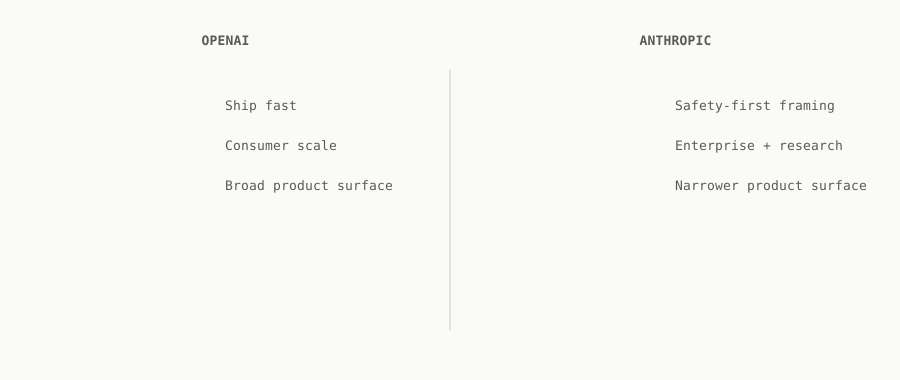
OpenAI and Anthropic get compared constantly, usually reduced to "ChatGPT vs. Claude." That framing misses most of what actually differs between the two companies, which is less about a single product and more about how each approaches building and releasing AI systems in the first place.
Origin and stated mission
OpenAI's stated mission is to ensure that artificial general intelligence benefits all of humanity, and the company has moved from a research-lab structure toward a much larger consumer and enterprise product company, with ChatGPT becoming one of the most widely used consumer software products of the decade. Anthropic was founded in 2021 by a group that included former OpenAI researchers, explicitly centered on AI safety research, with the stated view that safety and capability progress needed to move together rather than safety being treated as an afterthought.
Product philosophy
OpenAI has generally moved fastest on breadth — a wide product surface spanning consumer chat, developer APIs, image and voice generation, and enterprise tools, often shipping new capabilities aggressively and iterating in public. Anthropic's public communication, by contrast, has consistently emphasized a narrower, more deliberate approach: fewer product surfaces, more published research on model behavior and safety, and more explicit public reasoning about the tradeoffs behind release decisions. Anthropic's public research output on topics like interpretability and model alignment is a larger share of its public communication than is typical for a company its size.
Safety framing, in each company's own words
Both companies talk about safety extensively, but frame it differently. OpenAI's public materials tend to frame safety as something to be solved concurrently with capability development, with safety systems and usage policies layered onto rapidly shipping products. Anthropic's framing, laid out in documents like its Responsible Scaling Policy, treats safety evaluation as a gating step before certain capability thresholds are crossed, with more explicit public commitments about what would cause the company to pause or slow a release. Neither framing is objectively "more correct" — they reflect different bets about where the industry's biggest risks actually sit and how much deployment speed those risks are worth trading against.
What it looks like from inside a build
Running both APIs in production across a few of our own tools makes the philosophical difference concrete rather than abstract. Prompts that get a direct, useful answer from one model sometimes get a more cautious, hedged response from the other on identical wording — not because one model is "smarter," but because the refusal and caution thresholds are calibrated differently by design. That difference matters operationally: a support-bot or outreach-drafting feature built assuming one model's tone and boundaries will occasionally need adjusting when the underlying model is swapped, even with an identical prompt. It's a real integration cost, not just a philosophical curiosity.
Why this matters beyond the AI industry itself
For anyone building on top of these models — which increasingly includes small agencies and SaaS products, not just AI-native companies — the philosophical difference shows up practically in things like how conservatively a model refuses ambiguous requests, how much the underlying company publishes about model limitations, and how quickly new capabilities show up versus how much testing happens first. Neither approach is free of tradeoffs: faster shipping means faster access to new capability but less certainty about edge cases; slower, safety-gated releases mean more confidence in behavior but a longer wait for new features.
The healthiest way to read the comparison probably isn't "which company is right," but recognizing that having two well-resourced labs make different bets on this question is useful information for everyone else, since neither approach has enough of a track record yet to call it definitively correct. It's a similar build-versus-ship tension to the one covered in how Google actually ranks pages.