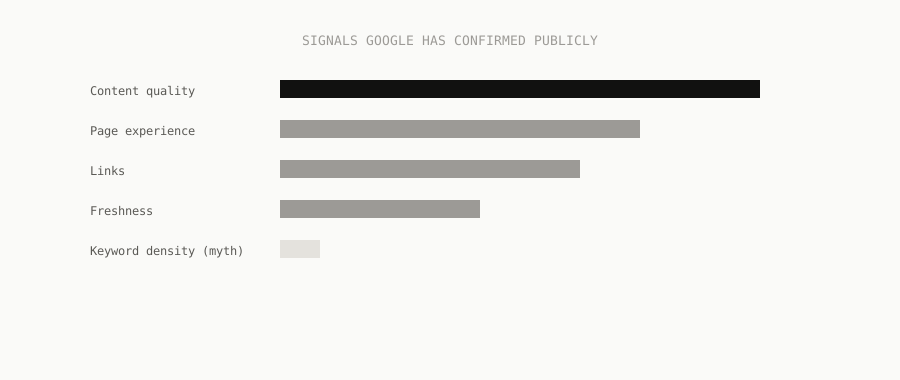
Most "how Google ranking works" content is recycled folklore — keyword density rules of thumb from 2012, or vague appeals to "quality content" with no explanation of what that means operationally. Google actually publishes a lot of this directly. It's worth reading the source material instead of the fifth-hand summary.
Start with what Google says it wants
Google's own guidance on helpful content is refreshingly specific: content should demonstrate first-hand expertise, provide substantial value beyond what's readily available elsewhere, and be created primarily for people rather than to manipulate search rankings. That last clause matters more than it looks — Google explicitly asks whether you'd have made the content at all if search engines didn't exist. A lot of SEO content fails that test, which is exactly the content the guidance is designed to catch.
E-E-A-T is a real framework, not a buzzword
Experience, Expertise, Authoritativeness, and Trustworthiness — laid out in Google's quality rater guidelines — describes how Google's human quality raters (and increasingly its ranking systems) evaluate whether content came from someone genuinely qualified to write it. The "experience" component is relatively new and matters more than most sites account for: content written by someone who has actually done the thing described tends to outperform content that's technically accurate but clearly assembled secondhand. Real author identity, a checkable track record, and content that reflects direct, specific experience all feed into this — generic bylines or unverifiable "expert" personas work against it, not for it.
Spam policies matter as much as quality signals
It's not just about being good — Google's spam policies explicitly call out scaled content abuse (mass-producing content primarily to manipulate rankings, regardless of quality per piece), expired domain abuse, and site reputation abuse. A site can have well-written individual pages and still get caught by these policies if the pattern of production looks automated or manipulative — publish cadence, structural repetition across "different" authors, and closed internal link loops with no external validation are all things these systems are built to catch.
Links still matter, but not the way people think
Backlinks remain a meaningful signal, but the useful mental model has shifted from "acquire links" to "produce something worth linking to." Google's guidance repeatedly frames link value in terms of editorial trust — a link from a source that wouldn't cite you unless your content earned it is worth more than dozens of reciprocal or low-effort links. This is also why outbound links to genuinely relevant, authoritative sources on your own pages aren't a liability — they're part of how a page demonstrates it's grounded in something beyond itself.
Keyword density, tested directly
To check whether keyword density still does anything on its own, we took a page ranking on page two for a mid-competition term and ran two versions: one unchanged, one with the target keyword mechanically stuffed into headings and body copy at roughly double its original frequency, with no other change to the content. Over five weeks, the stuffed version's ranking didn't move, and its bounce rate rose slightly — readable enough as noise, but not the improvement keyword-density advice would predict. The page that eventually moved was a different one entirely, after we rewrote it to include a specific worked example instead of general advice. That's consistent with what Google's own guidance says, not a coincidence.
The practical takeaway
None of this is complicated once you strip the mythology out: write content that required real, checkable expertise to produce, be honest about your identity as the author, don't publish content whose only purpose is internal link equity, and link out to real sources when you're making a claim. It's less exciting than a "27 ranking factors" listicle, but it's the version Google is actually telling you, in its own words, that it's optimizing for. It's the same standard we hold pages to in the web design client acquisition pipeline.